
India is navigating a complex diplomatic landscape, attempting to balance its 'forever honeymoon' with the Israel-UAE-Bahrain axis against its historical ties with Iran, as evidenced by recent high-level visits and evolving geopolitical realignments in the Middle East, observes Ambassador M K Bhadrakumar.

We are back to the 1971 moment with both China and the US supporting Pakistan, asserts Colonel Anil A Athale (retd).

US Vice-President J D Vance's unexpected phone call to Prime Minister Narendra Modi on August 8 has ignited speculation about a potential diplomatic overture, possibly seeking India's support amidst the escalating US-Iran conflict and a shifting global power landscape, suggests Ambassador M K Bhadrakumar.

It is an unusual choice to depute a retired general for the funeral of a revered religious figure but a thoughtful one in an attempt to inject verve into the bilateral relationship and restore the equilibrium in India's West Asian policies, notes Ambassador M K Bhadrakumar.

How US President Donald Trump employed a clandestine 'decoy' Air Force One operation to secretly depart Turkiye following a NATO Summit.

Pakistan Prime Minister Shehbaz Sharif announced that a US-Iran peace deal is on the verge of finalisation, potentially within the next 24 hours, marking a significant diplomatic breakthrough after months of intense negotiations.
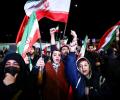
'American stature has been reduced because they have not been able to achieve their aims.'

A lesson for India is to clearly define objectives beforehand, so that the adversary or other parties do not attempt to mitigate them midway.

Iran's Supreme Leader Mojtaba Khamenei will not attend his father, former Supreme Leader Ali Khamenei's, funeral due to security concerns stemming from Israeli threats. This decision follows a sharp warning from Iran's Foreign Minister to the United States, urging it to control Israel after its Defence Minister reportedly marked Khamenei for death. The incident highlights escalating tensions and ongoing diplomatic efforts to de-escalate hostilities in West Asia.

The United States' historical strategic alignment with Pakistan, dating back to the Cold War, has consistently aimed to create a political and military parity with India, despite India's significantly larger size and resources. This long-standing relationship continues to influence regional dynamics, particularly in West Asia and the Indo-Pacific.

The harsh truth is that the US is no longer a reliable partner, cautions Ramesh Menon.
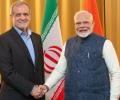
Prime Minister Narendra Modi held a telephonic conversation with Iranian President Masoud Pezeshkian, discussing recent developments in West Asia and reiterating India's emphasis on the importance of freedom of navigation in the Strait of Hormuz. Modi welcomed the recent peace understanding between the US and Iran, stressing dialogue and diplomacy for regional stability. India will also send representatives to the burial ceremonies of Iran's late Supreme Leader.

If the Iranian regime needs to be punished for promoting quasi-terrorist outfits like Hezbollah and Hamas, then what about Pakistan which has spent decades exporting terror around the world, killing thousands, particularly in Afghanistan and India? asks M R Narayan Swamy.
Prime Minister Narendra Modi has welcomed the understanding between the United States and Iran to end the conflict in West Asia, expressing hope that the pact will restore peace, stability, and ensure freedom of navigation in the region. The deal, aimed at ending a 107-day war that caused a global energy crisis, is set for signing on June 19.

Pakistan, Turkiye, and Saudi Arabia have signed a trilateral defence pact, agreeing to treat an attack on one as an attack on all. Analysts suggest this alliance could significantly diminish the United States' strategic influence in West Asia and elevate Pakistan's geopolitical standing, potentially acting as a deterrent in regional conflicts.

Iran was the chance to arrange a concert of nations, to actually be a Vishwaguru. Instead, we are watching from the sidelines as Pakistan, the same country that is apparently still at war with Afghanistan, hosts talks between US-Israel and Iran. The irony is hard to miss, points out Amberish K Diwanji.

By all available indications, the White House drafted a face-saving note and handed it, ready-made, to Islamabad. Pakistani Prime Minister Shehbaz Sharif was supposed to then post it in the guise of a plea urging Trump to extend the deadline by two weeks 'to allow diplomacy to run its course'. Trump would then graciously accept Pakistan's 'request' and declare a ceasefire. Sharif dutifully posted the message on X. Except that he, or whoever was handling the account, forgot to delete the tell-tale first line visible in the edit history: 'Draft - Pakistan's PM Message on X'. Prem Panicker's must read blog on the Iran War.

Iran has denied agreeing to participate in a second round of peace talks, contradicting claims made by the United States. The denial comes as tensions remain high in West Asia, with a ceasefire window nearing its end.
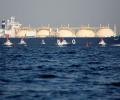
Iranian Deputy Foreign Minister Kazem Gharibabadi has urged India to take the lead in bringing peace to West Asia, highlighting the UAE's role in stalling BRICS consensus on the conflict. Gharibabadi also discussed a new framework with Oman for merchant vessels passing through the Strait of Hormuz.

Iran has reportedly allowed select "friendly nations" including India and Pakistan limited access to the Strait of Hormuz amid ongoing conflict, easing some energy supply concerns. Here's what the move means for global trade and oil routes.

Air India Group has accumulated losses of about Rs 47,821 crore since its takeover, leaving its prolonged transformation among the biggest unfinished projects of N Chandrasekaran's tenure.

If Trump wants peace with Iran, Pakistan will offer to help. If Trump seeks Pakistan's aid to spy on Iran, then too Munir will not hesitate to chip in. At the same time, the ISI will not hesitate to tip off Iran now and then, points out M R Narayan Swamy.

'The White House lunch that Trump hosted for Munir last year came just after Munir returned from a visit to Iran, at a moment when Israel and Iran were at war.' 'Trump said after that lunch that the Pakistanis know Iran very well. He likely views Munir as a useful interlocutor that can give helpful insights on Iran.'

Prime Minister Narendra Modi urged US President Donald Trump to prioritise the safety of Indian seafarers in the Strait of Hormuz during the implementation of Washington's proposed Iran peace deal, as both leaders focused on repairing strained bilateral relations at the G7 summit.

Gwadar is viewed as a critical pearl in China's maritime strategy as it would give a permanent logistical footprint near an important choke point - the Strait of Hormuz and the oil rich Persian Gulf, explains Commodore Venugopal Menon (retd).

Sonia Gandhi criticised PM Modi's Israel visit, calling it a "bewildering strategic decision" amid the regional conflict.

US Vice President JD Vance and Prime Minister Narendra Modi held a phone call to discuss expanding the India-US comprehensive global strategic partnership, focusing on trade, defence, energy security, emerging technologies, and critical minerals. The discussion comes amidst rising tensions in West Asia and recent regional realignments, with both leaders reaffirming their commitment to strengthening cooperation.

For India, much is at stake: Crucial energy supplies traversing the Strait of Hormuz, the fate of its 10 million citizens living and working in West Asia -- who send generous remittances home -- and its major trade links with the region.

The Ministry of External Affairs (MEA) has stated that India is closely monitoring developments in West Asia, addressing topics ranging from ceasefire efforts to maritime security and the safe return of Indian nationals. The MEA also addressed the UN Climate Change Conference and the delimitation bill.

External Affairs Minister S Jaishankar addresses the Indian Ocean Conference, expressing deep concern over the West Asia conflict and its economic repercussions on energy, trade, and food security. India calls for a swift return to peace and opposes targeting civilians and infrastructure.

'The flip side of this is that he won't hesitate to call out India if he thinks its policies are hurting US economic interests or border US foreign policy goals.'

A veteran White House reporter has revealed that the Clinton administration used a decoy aircraft during President Bill Clinton's high-risk visit to Pakistan in 2000, a security measure disclosed to journalists off-the-record due to the significant dangers involved.

Uncertainty surrounds the planned second round of peace talks between the US and Iran in Islamabad, as both sides engage in brinkmanship. Despite Pakistan's security preparations, Iran has yet to confirm its attendance, citing a lack of seriousness from the US in pursuing diplomacy and violations of the ceasefire.

The Congress party has criticised the Indian government's diplomatic efforts, questioning how Pakistan was able to secure a role as a mediator between the US and Iran despite India's attempts to isolate it after the Pahalgam attack. The party also raised concerns about India's standing on the global stage and its relationship with the US and China.

'We need to give Pakistan something serious to think about on its eastern front -- that is the only way to actually help Afghanistan right now.'

Congress leader Rahul Gandhi launched a scathing attack on the BJP-RSS, labelling them a "bunch of jokers" with no understanding of India, and criticised Prime Minister Narendra Modi's foreign policy as merely "hugging leaders." He also claimed the RSS has become an instrument of large capital, serving Adani and Ambani, and vowed that the Congress would keep pressure on the government until Modi and Shah resign. The BJP hit back, calling Gandhi immature and out of depth.

Iranian Foreign Minister Seyed Abbas Araghchi spoke with Indian counterpart S Jaishankar to discuss the West Asia crisis, following discussions with Russian President Vladimir Putin.

The Congress party has criticised the Modi government over Pakistan's involvement in US-Iran peace talks, calling it a 'monumental setback' for India's diplomatic efforts.

Trump has made it clear: the US will not lift its blockade of Iranian ports until a deal is signed.

Iran's state broadcaster denies sending a diplomatic delegation to Pakistan for talks with the US, despite reports suggesting otherwise. This denial comes amid escalating tensions and aggressive rhetoric from Washington, even as signs of potential diplomatic movement emerge.
